


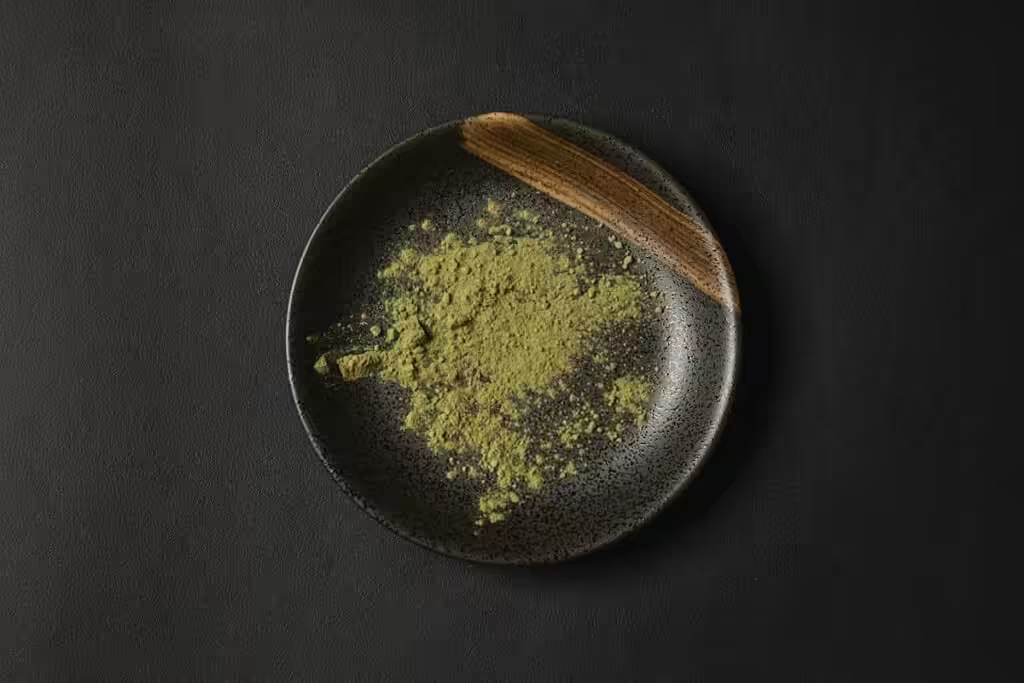
Matcha powder comes from finely ground green tea leaves of the Camellia sinensis (known as tea) plant. It is a premium product appreciated for its vibrant color, unique umami flavor, and health benefits like high antioxidants, caffeine, and L-theanine.
Originating from Japan, where it’s traditionally stone-ground from shade-grown tencha leaves, matcha necessitates careful handling from cultivation to consumption, which includes…packaging.
Here’s how to perfectly package matcha.
Table of Contents
Why is packaging matcha so tricky?
1. Oxidation
Matcha is hyper-sensitive to oxygen exposure. Even minimal air contact triggers enzymatic reactions that degrade chlorophyll, turning that signature emerald green to a dull brown, while diminishing flavors and nutrients like catechins and vitamins.
2. Humidity
Matcha absorbs moisture like a sponge, leading to clumping, mold growth, and bacterial contamination if relative humidity exceeds 60%.
3. Light
Light, especially UVs, accelerates photodegradation, fading color and potency.
4. Temperature
Temperature fluctuations can cause condensation inside packaging, exacerbating moisture issues.
5. Contaminants
Matcha powder’s fine particle size (often under 10 microns) makes it prone to picking up odors, dust, or foreign particles from the environment.
6. Static electricity
Static electricity during handling can cause powder to cling to surfaces, leading to uneven filling and waste.
7. Shelf life
Here’s how to properly pack up your matcha powder.
Step 1: Prepare Your Workspace and Materials
Before touching the matcha, set up a cleanroom-like environment. Get HEPA-filtered air systems to minimize airborne particles, humidity control at 40-50% RH, temperature stabilized at 18-22°C, and UV-protected lighting. Wear anti-static gloves, hairnets, and suits to prevent contamination.
Materials needed depend on your chosen method (we’ll cover options below), but universally:
- Packaging with oxygen transmission rates (OTR) below 0.1 cc/m²/day, moisture vapor transmission rates (MVTR) under 0.1 g/m²/day, and light-blocking properties.
- Nitrogen gas cylinders
- A vacuum packaging machine with nitrogen flush capabilities.
- Scales accurate to 0.01g
- Saling machinery (tin can seaming or doypack sealer)
Step 2: Choose Your Packaging Method
Matcha packaging is best done with a nitrogen flush.
Indeed, because matcha is made of ground tea leaves rather than whole ones, it has a massive surface area exposed to the air. Without a nitrogen flush, the oxygen trapped inside the container quickly degrades the chlorophyll and volatile oils, turning a vibrant emerald powder into a dull, yellowish-brown substance with a bitter, hay-like flavor.
By displacing oxygen with an inert gas like nitrogen, producers can effectively “pause” the aging process. This creates a stable environment that preserves the delicate L-theanine amino acids and the potent EGCG antioxidants that consumers expect. When combined with an airtight, light-blocking container, this method ensures that the tea remains as fresh as the day it was stone-ground, right up until the moment the consumer breaks the seal.
You really have two choices when it comes to matcha packaging. You can either package in a doypack/gusset aluminum bag, or directly in a tin can.
Option 1: Direct Packaging into Doypacks
Doypacks (stand-up pouches) are flexible, resealable, and space-efficient. They are the easiest and cheapest containers for matcha.
Start by selecting multi-layer doypacks with aluminum foil laminates for barrier protection. Weigh the matcha (typically 30-100g per pouch) using anti-static scoops to avoid powder adhesion.
Fill under a nitrogen blanket to displace oxygen while aiming for under 1% residual O2. Ensure to execute your nitrogen flush without vacuum sealing fully, as vacuuming crushes the powder into bricks.
This requires a modified atmosphere packaging (MAP) machine with precise gas injection and partial evacuation controls. Seal the doypack with heat or ultrasonic methods, ensuring hermetic closure without pinholes.
Option 2: Aluminum Gusset Bags Inside Tin Cans
Packing matcha into aluminum gusset bags isn’t any different from packing it inside doypacks.
Ensure that your gusset bags have vacuum-compatible aluminum foil with polyethylene liners. Measure and fill the bag similarly to doypacks, using nitrogen flush to minimize oxygen without full vacuum to prevent crushing. Seal the bag with impulse sealers and insert into a tin can.
Ensure that your tin can is food-grade with epoxy linings to prevent metal reactions. This double-layer setup shields against light and physical damage.
Tin can packaging is robust but labor-intensive. Ideal for premium ceremonial matcha.
Option 3: Direct Packaging into Tin Cans with Seaming
While this method excels for long-term storage (up to 18 months) it isn’t feasible on a DIY scale.
The can needs to enter a vacuum chamber where the oxygen is emptied ou, nitrogen is filled in, and the can is seamed mechancially.
Step 3: Implement Nitrogen Flushing Properly
While not legally required, nitrogen flushing is highly recommended for matcha packing to preserves freshness due to the oxygen accelerating oxydation.
Beware that nitrogen handling requires safety protocols to avoid asphyxiation risks.
Label with batch codes, expiration (6-12 months if done right), and storage instructions.
Step 4: Apply Batch Numbers and Expiration Dates
Every package must bear a unique batch number to track origins and destinations in case of recalls.
Calculate expiration dates meticulously: Based on stability tests under ICH guidelines (Q1A-Q1F), factoring in packaging efficacy, storage conditions, and initial quality assays; typically 6-18 months from packing, but verify with lab analysis to avoid liability for spoiled goods.
Step 5: Quality Control and Storage
Post-packaging, test rigorously: Use headspace analyzers for O2 levels, drop tests for durability, and accelerated shelf-life simulations (e.g., 40°C/75% RH chambers). Store in cool, dark warehouses.
Looking For a Matcha Co-Packer?
Most food co-packing companies work with big established brands and require MOQs in the thousands. We built Doypacked.eu to help small food entrepreneurs launch their product quickly and iterate until they find product-market fit.
- Looking for doypack, gusset bags, or tin cans co-packing?
- In need of dry powder mixing?
- Looking for vacuum sealing or nitrogen-flush?